

A New Mexico LLC Search returns the file the Secretary of State maintains on a limited liability company, whether organized under state law or admitted from another jurisdiction. That file opens with the articles of organization and gathers later documents as they are accepted, ending with a dissolution or cancellation when the registration closes. Everything in it was filed by the company or by its agent.
The material below tracks that file through its stages: how the company comes into being, who may act for it, which facts enter the public index and which stay private, how the articles change over time, and what a foreign company must do to enter or leave. Statutory charges are gathered in the table near the end, kept apart from the narrative so the two read separately.
Forming a Limited Liability Company in New Mexico
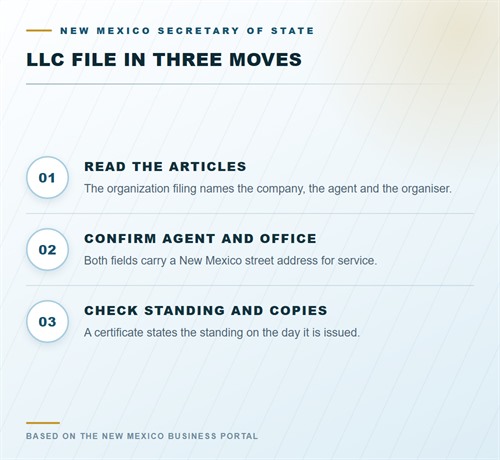
Organization begins when articles of organization are accepted by the Business Services Division. The document supplies the company name, a principal office, the identity and New Mexico street address of its registered agent, and the choice between member and manager management. A signed statement of acceptance accompanies it, and filing runs through the state portal, not on paper. A New Mexico LLC Search before drafting shows whether the name remains open.
New Mexico Secretary of State, statutes governing business entities, including the Limited Liability Company Act:
https://www.sos.nm.gov/business-services/statutes-governing-business-in-nm/
The Registered Agent Entry on an LLC File
Service of process and official notices reach a company through its registered agent, so the appointment is a permanent feature of the record rather than a formality. The agent’s name and street address appear in the public index, and a change to either produces a new filing. Absence of a valid agent leaves the company exposed to default judgments it never sees, and the gap shows as an address that no longer functions.
The Street Address Requirement
A post office box cannot serve, and neither can an address outside New Mexico. The agent must be reachable at a physical location in New Mexico during business hours, which is why commercial agent services maintain local offices. The address on file is the one the office will use for delivery, so an outdated entry can misdirect a court notice. Agent services charge for the work, and a company changing providers files the replacement.
Replacing an Agent or Moving the Office
A statement of change of registered office or agent replaces the appointment or relocates the office, and the company files it. Where the agent itself moves, a separate agent’s statement of change of address covers the update. Both are brief documents, and the agent details record shows how the appointment reads once the office has processed it. The later entry does not erase the earlier one.
Management Structure Stated in the Articles
The articles declare whether members or managers hold authority. That single designation shapes how the company contracts, who answers a demand, and what a third party may assume when dealing with someone who claims to speak for the business. It is visible to anyone who opens the record, and it can be altered by amendment at any later point. The designation governs outsiders, not the internal division of duties.
Member Management
Under member management, the owners direct the business and each may bind the company in ordinary dealings. Authority flows from ownership rather than from a separate appointment. An operating agreement can allocate duties among the members, but the public designation remains member management until an amendment changes it, whatever the internal document provides. A bank opening an account will look for a member’s signature.
Manager Management
Under manager management, named or appointed managers run operations while the members hold economic interests and voting rights on major decisions. Third parties look to the managers for authority, and a member acting alone may not bind the company. The division suits companies with passive investors or a professional management layer that sits above the ownership group and answers to it.
Switching Between the Two
A change of management structure is filed as an amendment to the articles. The new designation takes effect on acceptance, and the record then shows the later form. Internal documents should be revised at the same time so that authority described in an operating agreement matches what the state file reports to anyone who checks it. A mismatch invites disputes over who could sign.
Names the State Does Not Publish
The public file stops short of ownership. No list of members accompanies the articles, and no ownership percentages, capital accounts, or distribution terms enter the index. A searcher learns the company’s name, agent, addresses, status, and filing history, and nothing about who holds the equity or in what proportion. That silence is a feature of the statutory design.
Where Ownership Is Recorded Instead
Ownership terms belong in the operating agreement, which is kept by the company and never delivered to the Secretary of State. Membership changes are handled internally unless they also alter a filed item such as the company name or its management designation. The state file reflects structure, not the people behind it, and that gap is deliberate rather than an oversight. A buyer of the business looks to the agreement, not the index.
Managers and Their Appearance in Filings
A manager’s name reaches the public record only where a specific document names one, such as a filing that identifies a signatory. An organiser’s signature on the articles does not create a management listing. Requests for ownership information from the office therefore produce nothing, since the office never received the underlying facts in any form. The division answers only for what it holds.
No Annual Report Obligation
A limited liability company organized in New Mexico owes no annual report to the Secretary of State. No recurring filing keeps the registration alive, and no periodic charge follows from holding it. The company remains in good standing through the absence of any closing event rather than through repeated submissions on a calendar the office publishes. Nothing arrives in the mail to remind it of a deadline.
What Still Requires a Filing
Silence on the annual schedule does not mean the file stays accurate on its own. A new agent, a relocated office, a name change, or a restated set of articles each needs a document and the accompanying charge. Letting the agent appointment fall out of date is the most frequent way an otherwise current company creates trouble for itself. Notice of a lawsuit can go astray before anyone notices.
How Corporations Differ
Corporations carry a corporate report and pay a charge for it, which makes their calendar different from an LLC’s. Nonprofit corporations file under their own schedule as well. Anyone comparing entity types should treat the reporting duty as a feature of the form chosen, not as a general state requirement that applies to every registration. The obligations follow the statute that created the entity.
Amendments and Restated Articles
An amendment revises a named provision, such as the company name, the agent, or the management designation. A restatement replaces the articles wholesale while folding in earlier changes, producing a clean document that reads as a single instrument. The office charges the same amount for either, and both enter the history as separate entries with their own dates. Neither one removes what came before it.
Changing the Company Name
A new name must carry a recognized designator and must be distinguishable from names already registered. Checking the index before drafting avoids a rejection and a second submission. Where the new name is not yet wanted, a reservation holds it for 120 days while the amendment is prepared, and the hold is transferable to a successor. A lapsed hold frees the name for anyone else.
Correcting a Defective Filing
A document with an error can be corrected through a filing made for that purpose, and the correction attaches to the original entry rather than erasing it. The history shows both the flawed document and the correction, which preserves the sequence for anyone reviewing the file later. Correction is not the same as amendment, and the two are not interchangeable. Choosing the wrong one leaves the error standing.
Mergers, Conversions, and Consolidations
A merger combines two or more companies into one, a consolidation forms a new company from the participants, and a conversion changes the entity’s form without dissolving it. Each produces a filing with its own charge, and each leaves a trace in the surviving or resulting company’s record as well as in the records of those that cease. The disappearing companies do not vanish from the index.
Documents Accompanying a Merger
The plan of merger and the articles of merger are delivered together, and the office reviews them for the required statements before acceptance. A company formed in another state that merges with a New Mexico company may need to supply evidence from its home jurisdiction, since the office cannot verify status elsewhere on its own authority. Missing evidence holds the filing until it arrives.
Conversion into an LLC
Conversion lets a corporation or partnership continue as a limited liability company under a new statutory identity. The filing states the prior form, the new form, and the name carried forward or adopted. After acceptance, the record reflects the company as an LLC while the earlier corporate history remains visible in the file for anyone tracing its origins. Continuity of the entity ID is the point of the transaction.
Ending an LLC Registration
Articles of dissolution close the registration. The company should first settle its affairs, notify known creditors, and distribute what remains under the operating agreement and the statute. The filing itself is short, and the office charges a modest amount fixed by the schedule rather than measured against the size of the business or the value of its assets. Creditors with pending claims should be addressed before it goes in.
Settling Affairs Before Filing
Winding up means collecting what is owed to the company, paying or providing for what it owes, and distributing the balance. Members should confirm that no pending contract or lease will bind the company after closure. A dissolution filed too early can leave obligations attached to a company with no authority to act on them. A short delay costs less than an unfinished obligation.
What Remains on the Record
The file stays searchable after closure, showing the dissolution date and every earlier entry. Dissolution does not remove history, and a later reader can reconstruct the company’s life from formation onward. Any residual activity in winding up does not restore the authority to carry on new business under the same registration. A reopened business needs a new filing.
Foreign LLC Registration and Cancellation
A limited liability company formed in another state or country must obtain authority before transacting business in New Mexico. The application names the company, its home jurisdiction, its principal office, and a New Mexico registered agent with a street address, and it arrives with a certificate of existence issued by the home authority. Contracts made before registration can complicate the picture.
Amending a Foreign Registration
When the home name or jurisdiction changes, the company files an amendment to its New Mexico authority rather than starting a new application. The amendment keeps the original entity ID in place, which matters where contracts and licenses already reference that number. A fresh application would break that continuity and invite a second review. The amendment is also the cheaper route by the schedule.
Cancellation on Withdrawal
A company that stops doing business locally files a cancellation, which closes the New Mexico authority while the home-state organization continues. Cancellation is not dissolution. Tax clearance and other agency obligations may still need attention even though the registration with the Secretary of State has ended and the entity ID no longer supports new filings. The home file is untouched by the cancellation.
Copies, Certificates, and the File Itself
Requests for copies and certificates go to the Business Services Division, which keeps the accepted documents at its Santa Fe office in the Capitol Annex North. A certificate of good standing confirms the registration stands in effect on the issue date, while a certified copy authenticates a specific document taken from the file. Both are produced from the same stored images.
Which Document a Bank Will Accept
Lenders and out-of-state agencies generally want a certificate of good standing, sometimes paired with a certified copy of the articles. A plain copy rarely satisfies an external reviewer because it carries no seal. Asking the recipient which document it requires avoids ordering a paper that will be turned back at a closing table. Orders are not refunded when a form proves wrong.
Reading an LLC File Alongside Others
A company that converted from a corporation leaves corporate entries behind, so the full picture sometimes spans more than one type of record. The entity records guide covers how those entries are arranged across the index when a single file does not tell the whole story on its own. Entity IDs connect the pieces.
Fees Fixed by NMSA 53-19-63
The limited liability company schedule is statutory, uniform statewide, and tied to the document rather than to revenue or headcount. Amounts for the filings covered on this page appear below, along with the copy and certificate charges collected by the same office. Nothing in the schedule varies by county, by filing method, or by the age of the company. The citations sit in the statute, not in an office policy manual.
Charges That Repeat
Each filing draws its own fee, so a company amending twice pays twice, and a foreign company that registers and later amends pays for both filings. Copies and certificates are billed per document requested. A held name lasts 120 days, renewal takes another filing, and the hold can pass to a successor. Budgets should count documents rather than years.
| Item | Amount |
|---|---|
| Articles of organization | $50 |
| Amended or restated articles | $50 |
| Merger, conversion, or consolidation | $100 |
| Dissolution or revocation | $25 |
| Certificate for any other purpose | $25 |
| Written information | $25 |
| Plain copy | $10 |
| Certified copy | $25 |
| Name reservation or transfer | $20 |
| Statement of change of registered office or agent | $20 |
| Agent’s statement of change of address | $20 |
| Foreign LLC registration | $100 |
| Foreign LLC amendment | $50 |
| Foreign LLC cancellation | $25 |
Frequently Asked Questions
Questions that come up repeatedly about the limited liability company record are answered briefly here.
Is a yearly filing due for an LLC?
No. New Mexico imposes no annual report on a limited liability company, and no periodic charge follows from the registration. Corporations instead file a corporate report under the corporate schedule.
Can a member list be obtained from the state?
No. The office never receives a member roster. Names of members, their percentage interests, and their contributions remain in the operating agreement, which stays an internal document. A request to the division for that list returns nothing.
What makes a registered agent valid?
A physical street address inside New Mexico, with no post office box accepted. The initial agent also signs a statement of acceptance that travels with the articles of organization. A commercial service may fill the role.
How long is a name held?
A reservation secures a name for 120 days and may be transferred. The charge follows the LLC schedule, and a corporation reserving a name pays according to the corporate schedule instead.
Does a foreign LLC need its own agent?
Yes. Authority to transact business requires a New Mexico registered agent with a state street address, plus a certificate of existence from the home jurisdiction. Registration is separate from the home-state organization.
What happens after dissolution is filed?
The registration closes and the file shows a dissolution date while earlier documents remain. Authority to conduct new business ends, though winding-up tasks may continue for a period afterward. New business needs a new registration.