

The New Mexico Corporation Search index is maintained by the Secretary of State as the state’s central register of business entities. Every corporation formed in New Mexico or admitted to do business there appears in that file, alongside limited liability companies, limited partnerships and limited liability partnerships. The register records what a corporation filed, when it filed, and which people carry responsibility for it.
A corporation’s life in the register begins with articles of incorporation and continues through corporate reports, amendments, mergers and dissolution. Each instrument leaves a trace that any member of the public can inspect. Read in order, those traces give a factual account of the entity’s standing, its officers and directors, the agent who accepts service, and whether the charter remains active.
What the New Mexico Corporation Search Contains
The Business Services Division keeps a separate file for every domestic corporation formed under the Business Corporation Act and every foreign corporation granted a certificate of authority. The file holds the formation document, the report history, amendments, merger records and any dissolution or withdrawal papers. Those filings feed the New Mexico Corporation Search result, which shows the entity name, agent, principal office and current status.
New Mexico business filing office and forms:
https://www.sos.nm.gov/business-services/
The Articles of Incorporation File
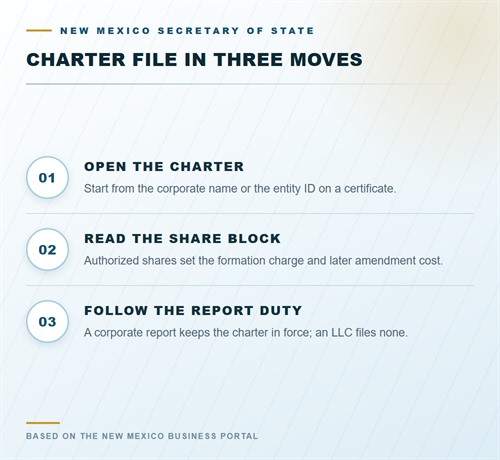
A domestic corporation comes into existence when articles of incorporation are accepted and filed. The document names the corporation, states its purpose, identifies the registered agent and registered office, lists the initial directors, and sets the number of authorized shares the corporation may issue. That share figure drives the charge collected at formation. It also governs the cost of later amendments that raise the authorization.
Contents Required in the Articles
The articles must give a corporate name distinguishable from names already on file, a period of duration if it is not perpetual, and the purpose for which the corporation is organized. They also carry the address of the initial registered office, the name of the initial agent, and the number of shares the corporation is authorized to issue.
How Authorized Shares Set the Charge
The office charges by the share block rather than by a single flat amount. Each thousand authorized shares carries a rate set in NMSA 53-2-1, subject to a statutory floor and a statutory ceiling. A corporation authorizing a small block pays the floor, while a very large authorization reaches the ceiling. The rate is fixed by statute rather than set by the office.
Reserving a Corporate Name
A proposed corporate name must be distinguishable from names already on file with the office. A reservation holds an approved name while the articles are prepared, and the reservation can be transferred to another party. A reservation does not itself create a corporation, and it lapses if no formation document follows. The charge appears in the table below.
End of Paper Formation Filing
Formation documents go through the state’s business portal at enterprise.sos.nm.gov. The office stopped accepting paper articles, so a new charter exists only as an electronic record. The electronic submission becomes the filed document, and it is the version the public search displays. A filer who drafts the articles on paper still has to submit them through the portal.
Domestic and Foreign Charters in One Register
Both a domestic charter and a foreign authority appear in the same register, and both carry a status field. The distinction matters when a reader tries to follow the filings, because the instruments available to each type differ. A domestic corporation amends, merges and dissolves inside the state system, while a foreign corporation updates an authority and eventually withdraws it.
Domestic Corporations
A domestic corporation holds its charter from New Mexico. Its record contains the articles, every amendment and restatement, the report history, and the final dissolution papers if it has closed. The status field shows whether the charter is active, out of compliance, or dissolved, and the document list shows the order in which those filings arrived.
Foreign Certificates of Authority
A corporation formed in another state or country enters the New Mexico register by obtaining a certificate of authority. The application identifies the corporation, its home jurisdiction and its New Mexico agent. The authority permits it to transact business in the state without incorporating a second time under local law.
Withdrawal From the Register
A foreign corporation leaves the register by filing an application for withdrawal. The filing confirms that the corporation no longer transacts business in New Mexico and that it consents to service of process for claims arising from its earlier activity. The office then closes the authority. The file itself is not removed, and the closed authority stays visible beside the earlier filings.
Reading the Status Field
The status field summarizes the charter in a word or short phrase. Active means the corporation is current with its filings. A note about noncompliance means a required submission is missing, and dissolved means the charter has ended. The field reflects the register at the moment of viewing, so a status read last week may not match the file today.
Officers and Directors on the Record
A corporation’s file identifies the people who run it, but the roster moves as terms end and officers change. Initial directors are named in the formation document, and later updates arrive with the corporate report. Reading both instruments in order reconstructs who held which office at a given time. The file keeps no separate historical table, so that reconstruction depends on the documents themselves.
Initial Directors in the Articles
The articles name the directors who serve until the first annual meeting. Their addresses appear with their names, which is one reason a formation document discloses more personal detail than a bare charter would suggest. That first roster anchors the corporate history for later readers, and the directors named there serve until a successor is chosen.
Officers Named in the Corporate Report
The report discloses the president, the secretary and the treasurer, or the officers performing those functions under other titles. It also lists the directors then serving and the address of the principal office. Together those names show who signs for the corporation and who directs it. Titles vary between corporations, so the office reads the function rather than the label.
Reading a Stale Roster
The identities in the file are only as current as the last submission. A corporation that has skipped its report leaves names behind that no longer reflect its management. Anyone relying on the roster should check the filing date against the entity records entry before treating it as present fact.
The Corporate Report Duty
A New Mexico corporation files a corporate report on the cycle the Secretary of State assigns. The obligation is recurring, and it is the clearest division between the corporate form and the limited liability company, which files no annual report with the state. The charge for the report appears in the schedule below.
The Filing Cycle
The office assigns a reporting month when the charter is filed, and the corporation reports in that window thereafter. The report confirms the officers, directors and agent, or corrects them. A corporation that changes management between reports waits for the next cycle or files a separate statement. The report is short and is submitted through the portal like other filings.
Compliance Status
A missed report moves the charter out of compliance. The status field reflects that condition, and a certificate of good standing will not issue while it lasts. Lenders and landlords who check the register see the same field, which is why the report is treated as routine rather than optional.
Reinstatement After Dissolution
Administrative dissolution follows prolonged noncompliance. Restoring the charter requires a letter of reinstatement, and the corporation must clear the filings it missed. The register then shows an active charter again, with the gap visible in the document history for anyone who reads the file closely. The office issues the letter once the record is current.
Amendments and Restated Articles
A corporation alters its charter by amending the articles. The filing is priced according to what the amendment does to the authorized share block, so two amendments of similar length can carry very different charges. Restated articles are handled on the same principle. The office looks at the effect on the share count rather than at the amount of text the document changes.
Amendments That Increase Authorized Shares
An increase in authorized shares is charged on the added shares at the per-thousand rate, subject to the same floor and ceiling that governed formation. The office measures the difference rather than the total authorization, so a modest increase may still meet the minimum charge. The formula is the one applied at formation, which keeps the charge consistent over the life of the charter.
Amendments That Do Not Touch Shares
A change of corporate name, purpose, duration or agent is charged at a single fixed amount. These are the routine amendments, filed when a corporation rebrands or moves its office. The charge does not vary with the length of the document or the number of clauses it alters, and a combined name and address change still carries the one amount.
Restatement of the Whole Document
A restatement replaces the articles in their entirety rather than altering one clause. If the restated document raises the authorized share block, the difference in the per-share charge applies. If it leaves the share figures alone, the flat amendment charge applies instead. A restatement is often filed after several amendments have made the original text hard to follow.
Share History in the File
Each share-related filing stands on its own in the document list. Articles, amendments, series designations and reductions appear separately, with dates. A reader who wants the current authorization starts with the original figure and applies each instrument in order rather than trusting a single total drawn from the summary view.
Series of Shares and Reduction of Authorized Shares
Share structure can be adjusted after formation in two directions. A corporation may carve a series out of an authorized class, or it may reduce the total number of shares it is authorized to issue. Each act is a distinct filing with a fixed charge and its own place in the document history.
Establishing a Series
A series of shares is created within an authorized class, with terms set by the board and recorded in a filing with the state. The record then shows the class, the series and the total authorized amount together. Series let one group of holders carry rights that differ from another group inside the same class.
Reducing the Authorized Block
A reduction lowers the number of shares the corporation may issue. The state charges a fixed amount for the filing and does not refund any part of the original formation charge. A share history therefore has to be read instrument by instrument, because the totals change at each filing. The filed reduction shows the new total while the earlier figure stays visible in the document before it.
Merger, Consolidation and Exchange
A merger ends the separate existence of at least one corporation and passes its undertakings to a survivor. A consolidation forms a new corporation from two or more predecessors, and an exchange transfers shares without dissolving the acquired entity. All three are recorded in the register when a New Mexico charter is involved.
Articles of Merger
The survivor files articles of merger with the Secretary of State. The charge sits within a statutory band rather than on a per-share basis, so the cost does not scale with the size of the authorized block. The absorbed corporation’s record closes with a reference to the merger, so a reader can follow the business forward from the older charter.
Copies of Foreign Mergers
When a foreign corporation merges and the transaction touches a New Mexico entity, a copy of the foreign merger may be placed in the file. That copy is billed at its own rate. The document preserves the chain of succession inside the state record even though the merger itself was effected elsewhere.
Dissolution of a Domestic Corporation
Dissolution is a process rather than a single filing. A corporation first signals its intent, then winds up its affairs, then files articles of dissolution once the work is done. Each instrument is recorded, and each carries a charge that the table below sets out. Leaving out a stage leaves the record incomplete in a way that later readers can see.
Intent to Dissolve
The statement of intent tells the office and the public that the corporation has begun to wind up. It does not end the charter. Creditors and claimants have a window in which to act, and the corporation continues to exist during that period as a live entity that still files.
Articles of Dissolution
Articles of dissolution are filed after the assets are distributed and the liabilities settled. The office closes the charter when the articles are accepted. The record keeps every earlier document, so the corporate history stays readable after the entity has ended. The closing entry gives the date the charter ceased to exist.
Revoking the Intent
A corporation that changes course may revoke its intent to dissolve. The revocation is a filing with its own charge, and it returns the charter to the status it held before the intent was recorded. The file then shows the intent and its revocation side by side, each with its own date.
Certificate of Good Standing and Copies
A certificate of good standing and compliance states that a corporation exists and has met its filing obligations. Counterparties ask for it before signing contracts, opening accounts or closing a loan. The certificate speaks as of its issue date and can be overtaken by a later filing. One issued while a submission is still pending may not reflect that submission.
What the Certificate States
The certificate gives the corporate name, the date of incorporation, the fact of good standing, and the office seal. It does not recite the officers or the share structure. A reader who needs those details requests copies of the underlying filings instead. The wording is standard, so two certificates can be compared to see how standing changed between dates.
Plain and Certified Copies
Filed documents are available in two forms. An unsealed duplicate is enough for a working file. A certified copy bears the office seal and is the version courts and out-of-state agencies normally accept. Both are produced from the same electronic record, so their text does not differ. The certified version is normally requested when the document will be used outside New Mexico.
Where to Request Them
Requests go to the division’s Santa Fe office on Don Gaspar Avenue, Suite 300, or through the business portal. A reader who wants the agent history alongside the certificate can follow the registered agent entry for the same corporation. Filings and copy requests may be submitted in the same portal session.
Corporation Filing Fees
The schedule below lists the charges a corporation meets most often, drawn from NMSA 53-2-1. Instruments priced on authorized shares carry statutory floors and ceilings, while statements, reports and certificates carry fixed amounts. The office collects each charge when the filing is submitted. For share-based items the figure follows from the corporation’s own articles.
| Item | Amount |
|---|---|
| Charter filing (articles of incorporation) | $1 per 1,000 shares; $100 floor; $1,000 cap |
| Amendment or restatement increasing shares | Difference in per-share charge, minimum $100, maximum $1,000 |
| Amendment or restatement not increasing shares | $100 |
| Merger, consolidation or exchange | Minimum $200, maximum $1,000 |
| Series of shares | $100 |
| Reduction of authorized shares | $100 |
| Name reservation or transfer | $25 |
| Change of registered office or agent | $25 |
| Agent’s statement of change of address | $25 |
| Intent to dissolve, revocation, or articles of dissolution | $50 |
| Foreign certificate of authority | $1 per 1,000 shares, minimum $200, maximum $1,000 |
| Foreign amended certificate of authority | $50 |
| Copy of foreign merger or conversion | $200 |
| Withdrawal | $50 |
| Corporate report | $25 |
| Any other statement, corrected document or report | $25 |
| Certificate of good standing and compliance | $50 |
| Letter of reinstatement | $200 |
| Plain copy | $10 |
| Certified copy | $25 |
Frequently Asked Questions
The answers below address points that arise when a corporation’s record is read in the state register.
Does a New Mexico corporation file an annual report?
It files its corporate report on the office schedule, and the form is not labelled an annual report. The charge appears in the table above. A limited liability company files no annual report at all.
How is the incorporation charge calculated?
The office charges per thousand authorized shares, subject to a statutory floor and ceiling. Small authorizations sit at the minimum, and very large ones hit the maximum instead.
Can a foreign corporation amend its New Mexico record directly?
It files an amended certificate of authority to update its details. If it stops transacting business in the state, it files a withdrawal and the authority closes at that point.
What follows a missed corporate report?
The charter falls out of compliance and may be administratively dissolved. Restoring it requires a letter of reinstatement, and the missed filings must be cleared before the register shows an active charter again.
Who appears as an officer in the register?
The corporate report names the president, secretary and treasurer or their equivalents, together with the directors serving when it was filed. The roster is only as current as that submission.
Is a good standing certificate the same as a copy of the file?
No. The certificate is a dated statement that the corporation exists and complies with its filing duties. A copy reproduces filed documents in plain or certified form, at the charges listed in the table.