

Every business entity on the New Mexico register must designate a registered agent, and that designation is a public field on the entity’s record. The New Mexico Registered Agent entry shows who accepted the appointment, where the registered office sits, and whether the appointment has been changed or resigned since. It is the contact point the state uses for official correspondence.
The field carries legal weight beyond its appearance in a database. Service of process, notices from the Secretary of State and court papers go to the agent at the registered office. A stale or defective entry creates practical problems for the entity, and the register shows that condition to anyone who looks.
Where the Appointment Appears on a Record
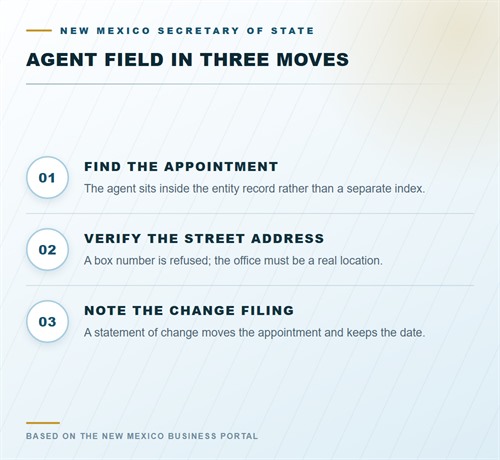
The public business search at enterprise.sos.nm.gov returns the entity name, status, principal office and agent in a single view. The entry names the individual or commercial service and gives the New Mexico street address of the office. Those filings supply the New Mexico Registered Agent details displayed for each entity, drawn from the documents rather than from a separate agent registry.
Filings Behind the Search Result
The search result summarizes documents held in the division’s files. The formation document names the first agent, and each statement of change adds a later entry. When a summary looks inconsistent with an older copy, the filed instruments take precedence, and a copy of the file settles the question. The dates in the document list show which entry is current.
New Mexico registered agent help and filing guides:
https://www.sos.nm.gov/business-services/user-guides/
Who May Serve as Registered Agent
The statute allows two kinds of agent, and the register treats them alike. An individual must be a New Mexico resident with a street address in the state. A business entity must be authorized to transact business in New Mexico and must keep a place of business there. Neither form of appointment is preferred over the other.
Individual Agents
An individual agent is normally an officer, director, member or manager of the entity, or a resident who agrees to the role. The person must be physically present and reachable at the registered office during business hours. Residence outside New Mexico disqualifies the appointment even if the person owns the entity.
Entity Agents
A commercial registered agent service, a law firm or another corporation may hold the appointment when it is authorized to transact business in New Mexico. The entity must have staff at the address who can receive papers. Its authority to do business in the state is checked against the same register it is serving.
What Acceptance Requires
Accepting the role means agreeing to forward legal documents to the entity at its last known address. The duty does not end when the entity stops answering mail. An agent that wants out must resign through a filing rather than ignore the deliveries that keep arriving. The obligation follows the appointment, not the person’s other roles in the business.
The New Mexico Street Address Rule
The registered office must be a physical street address located in New Mexico. A post office box will not satisfy the requirement, and neither will an address outside the state. The office need not be the entity’s place of business, but it must be a location where a person can accept delivery.
Boxes and Out-of-State Addresses
A formation document that gives a box or an out-of-state address is rejected at intake. The office checks the address before it accepts the filing, and the entity does not come into existence until a compliant address is supplied. The same check applies to a statement of change. The address must point to a place where a person can be found, not to a receptacle.
Moving the Office
An entity that relocates its registered office reports the move on a statement of change. If the agent stays the same and only the street address differs, the agent files a statement of change of address. Either way the public record is corrected, so the register never points to a place where service cannot be made.
Address in the Formation Document
The street address appears in articles of incorporation and in articles of organization, printed beside the agent’s name. That placement makes the office part of the formation record rather than a separate attachment filed later. A reader can therefore see the original office and every correction in sequence. The address is stated in full, not abbreviated or deferred to a later schedule.
The Statement of Acceptance Filed with Formation
The designated initial agent signs a statement accepting the appointment, and that statement accompanies the formation filing. Signing confirms that the agent knows of the designation and agrees to the duty. Without the acceptance, the formation document is incomplete and the entity does not come into existence. The signature is made before the document is submitted through the portal.
Signing at Formation
The acceptance is filed once, at the start, and it does not renew. It is a consent document rather than a license, so no periodic filing keeps it alive. What changes afterward is the designation itself, reported through a statement of change when the agent or office is replaced. The signature page is part of the filed document, visible to anyone who orders a copy.
Acceptance Versus Later Change
The acceptance and the statement of change are separate instruments with separate purposes. One establishes the appointment, the other relocates it. Reading an entity’s file in order shows the original acceptance, then each subsequent statement, and finally any resignation if the agent left before the entity closed. The acceptance is the starting point of that chain.
A Missing Acceptance
An appointment without a signed acceptance leaves the formation filing deficient. The office returns the document rather than recording an agent who has not consented. A reader who finds no acceptance in the file is looking at an incomplete submission rather than an oversight in the search result. The deficiency can be cured by resubmitting the document with the signature attached.
Commercial and Noncommercial Agents
A commercial agent holds appointments for many entities at one address and charges a fee for the work. A noncommercial agent is typically an officer, director, member or resident individual acting for a single entity, often at its own premises, without a service contract. Both types meet the statute on the same terms.
Registered Agent Services
A service maintains a staffed office, receives deliveries during business hours and forwards them under contract. Many entities use one provider for several states, though each state requires its own office within its borders. The New Mexico address must still be a New Mexico street address, not a mail drop elsewhere.
Officers and Members Acting as Agent
A small entity often names its own president or managing member to avoid a service fee. That choice works while the person remains in the state and keeps the address current. It can fail when the officer moves, resigns or loses contact with the business, because the register keeps the old address until a filing changes it.
Telling Them Apart in a Record
The register does not label an agent as commercial or noncommercial. A reader infers the type from the name and the address. A name matching a known service, paired with an address shared by hundreds of entities, indicates a commercial appointment, while a personal name at a business premises usually indicates the other kind.
Change of Agent or Registered Office
An entity changes its agent or office by filing a statement of change with the Secretary of State. The filing updates the public record and takes effect when accepted. The charge is fixed and modest, and it differs by entity type, as the schedule below shows. The form requires the entity’s name and the old and new appointment details.
Who May File the Statement
The statement is filed by the entity and recorded against the entity’s own file rather than against a separate agent register. A document that names the wrong entity is returned rather than accepted, so the record stays tied to one charter. The filing must identify the current appointment as well as the replacement.
Filing the Statement
The statement identifies the entity, the current agent and office, and the replacement. It is submitted through the business portal and is accepted or returned after the office reviews it. A returned statement leaves the old entry in place, so the record does not change until a compliant filing is accepted.
Effect on Other Terms
A statement of change does not alter any other term of the formation document. The entity keeps its name, its charter and its history. Only the agent and office fields move. Nothing else in the file is reopened by the filing, and no new formation document is created. Two snapshots of the file taken before and after show only the agent lines moving.
Charges by Entity Type
Corporations, LLCs and nonprofits each price the statement under their own fee section, and the figures are not identical. The same is true of the certificate of good standing and of copies. A filer should confirm the amount that matches the entity type before submitting. The table groups the three schedules so they can be compared side by side.
Service of Process and the Agent’s Duty
Service of process on an entity is made by delivering the papers to the agent at the registered office. That delivery binds the entity whether or not its officers learn of the suit immediately. The agent’s obligation is to forward the documents to the entity at its last known address.
Delivery to the Office
The plaintiff’s process server goes to the street address on file. Delivery there is effective even if the named agent is absent, provided a person at the office accepts the papers. This is why the statute insists on a staffed physical location rather than a mailbox that no one monitors.
Substitute Service on the Secretary of State
When an entity has no valid agent, service may be made on the Secretary of State as a substitute, and the state forwards the papers. That route is slower and can leave the entity unaware of a deadline. A current entry on the corporation record avoids the gap entirely. The forwarding address used is the principal office on the record.
Resignation by an Agent
An agent may resign by filing a statement of resignation with the office, which then notifies the entity. The appointment ends on the date the filing takes effect, and the entity must name a replacement. Until it does, the record shows no valid agent and substitute service becomes possible. A resignation appoints no successor.
Privacy of a Home Address
The registered office is public. An individual who accepts an appointment at a home address places that address in the state register, where anyone using the search can read it. Nothing in the filing system conceals the office address once the document is accepted. A request for a copy of the formation document discloses it again in full.
What the Register Discloses
The search result prints the agent name and the street address together. Copies of the formation document repeat them. A person who later changes the office does not erase the earlier address, because the older instrument stays in the document history and can be requested as a copy. The same holds for the agent’s name at the time of each filing.
Choosing Another Office
An individual who prefers not to disclose a residence may appoint a commercial service or use business premises instead. The statute requires a street address in New Mexico, not a particular kind of address. Choosing the office is therefore a decision about disclosure as much as about logistics, and it can be revisited by filing a change.
Agent Services and Disclosure
A service address is public in the same way, but it is a business location rather than a home. Entities that want the agent field to point somewhere other than an owner’s residence usually appoint a service for that reason alone. The register makes no distinction between the two choices.
Reading the Agent Field Across Entity Types
The same structure applies to every entity in the register, covering companies, charities, and both forms of partnership, whether domestic or foreign. The field looks identical in search results regardless of the statute that governs formation. What differs is the fee attached to changing it, since each form has its own schedule.
Corporations and Nonprofits
A business corporation and a nonprofit corporation both name an agent and both report changes the same way. What separates them is the fee schedule that applies, since each form has its own section of the statutes. A nonprofit that appoints a commercial service reports the change at the amount its own schedule sets.
Partnerships and Limited Liability Partnerships
Limited partnerships and limited liability partnerships appear in the register with the same agent field. A foreign partnership admitted to do business in the state carries a New Mexico office as well. The street address rule applies equally, and the LLC records listing shows the equivalent field for that form.
Agent Change and Certificate Charges
The amounts below cover the filings that touch the agent field, plus the certificate and copy charges that accompany them, set out by entity type. The corporation figures come from NMSA 53-2-1, the LLC figures from NMSA 53-19-63, and the nonprofit figures from NMSA 53-8-85. The three schedules do not move together, so a change priced for one form carries a different amount for another.
| Item | Amount |
|---|---|
| Corporation: change of registered office or agent | $25 |
| Corporation: agent’s statement of change of address | $25 |
| Corporation: certificate of good standing and compliance | $50 |
| Corporation: plain copy | $10 |
| Corporation: certified copy | $25 |
| LLC: change of registered office or agent | $20 |
| LLC: agent change of address | $20 |
| LLC: certificate for any other purpose | $25 |
| LLC: plain copy | $10 |
| LLC: certified copy | $25 |
| Nonprofit: change of registered office or agent | $10 |
| Nonprofit: agent change of address | $10 |
| Nonprofit: certificate of good standing | $10 |
| Nonprofit: plain copy | $10 |
| Nonprofit: certified copy | $25 |
Where Filings Are Made
Filings and copy orders reach the division’s counter in Santa Fe, inside the Capitol Annex North building. Statements of change, formation documents and requests for certificates all pass through that office. Questions about a pending filing go to its staff rather than to the portal’s technical support.
Office and Counter
The Santa Fe counter handles in-person inquiries during business hours, including copy requests and questions about a rejected submission. Records for every entity type are held at the same location. A visitor can review a file and order certified copies in one trip. A large copy order may take time to prepare.
Portal Submissions
Filings are made online through the New Mexico Business Portal at enterprise.sos.nm.gov, and paper filing for business formation has been discontinued. A statement of change submitted through the portal updates the search result once accepted. No separate publication follows acceptance, and no notice is mailed to third parties. The date of acceptance appears in the document list for later reference.
No Notice to Third Parties
Nothing in the process alerts a bank, a landlord or a counterparty that the agent has changed. Those parties learn of it only by checking the register again. An entity that wants a lender to update its file must tell the lender directly, because the state filing reaches the public record alone.
Frequently Asked Questions
These answers cover the agent field as it is recorded, changed and read in the state register.
Can a post office box serve as the registered office?
No. The office must be a physical street address in New Mexico where a person can accept delivery. A box address causes the formation filing to be rejected at intake.
Does the agent’s acceptance need to be renewed?
No. The statement of acceptance is filed with the formation document and stays in the file. Later alterations are made by filing a statement of change instead of a fresh acceptance.
Who may be named as an agent in New Mexico?
An individual resident of the state, or a business entity authorized to transact business there with a place of business in New Mexico. Either must hold a street address within the state.
How does an entity replace its agent?
It files a statement of change with the Secretary of State through the business portal. The charge depends on whether the entity is a corporation, an LLC or a nonprofit corporation.
What if the entity has no valid agent on record?
Service can also reach the office when no valid agent exists, and staff then pass the papers along. That path can delay the entity’s awareness of a court deadline.
Is an agent’s home address visible to the public?
Yes. The registered office is part of the public record and appears in search results. An individual who wants to avoid that disclosure appoints a commercial service or uses business premises.